
Quantum Sensing Metamaterials
Three-dimensional photonic crystal architectures engineer the local density of optical states around solid-state quantum emitters such as nitrogen-vacancy centers. Purcell-enhanced emission, chiral polarization selectivity and spectral filtering form the basis of chip-scale sensors for magnetic field, temperature and strain.

Civil and Building Infrastructure
Architected lattices introduce membrane-dominated load transfer to civil structures. Permanent lattice formwork provides three-dimensional reinforcement for ultra-high-performance concrete, topologically graded structural nodes dissipate seismic and blast energy, and facade panels combine impact resistance with internal channels for thermal regulation. The same approach extends to vibration-isolating substructures for bridges and rail, energy-dissipating coastal armor and permeable high-load pavements.
Semiconductor Metrology
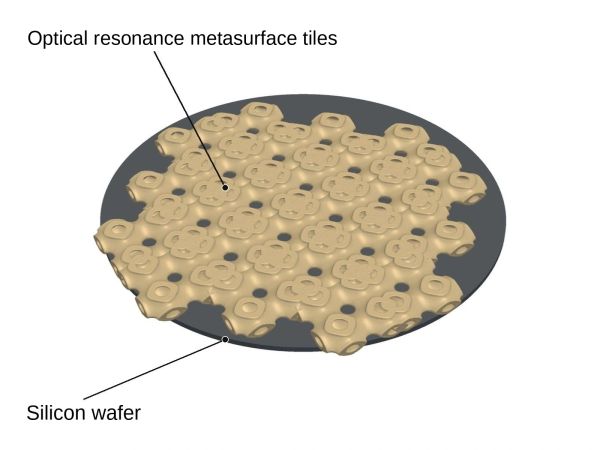
Engineered metasurfaces create sharp optical resonances, including quasi-bound states in the continuum, that respond to nanometer-scale changes in geometry. They enable super-resolution critical dimension metrology, in-line defect and sidewall profiling and quantum-enhanced alignment marks for advanced lithography.
Wearable Electronics
Lightweight frames, housings and straps for headsets, watches and smart eyewear combine structural rigidity with ventilation for thermal comfort at the skin and radio-frequency transparency for uninterrupted wireless connectivity.
Robotics
Grippers, skins and limbs that carry load while sensing contact, regulating temperature and communicating through a single printed structure, providing tactile awareness and damage tolerance without added mass.
Thermal Management Systems
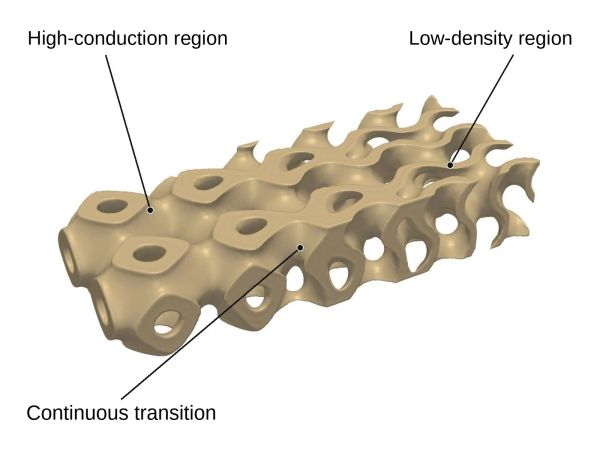
Hybrid architectures that transition between lattice families within a part grade heat conduction independently of density, forming lightweight heat spreaders for processors and data centers, high-conductivity composite frameworks and passive heat-rejection structures for space and high-altitude computing platforms.
Embedded Sensing and Health Monitoring
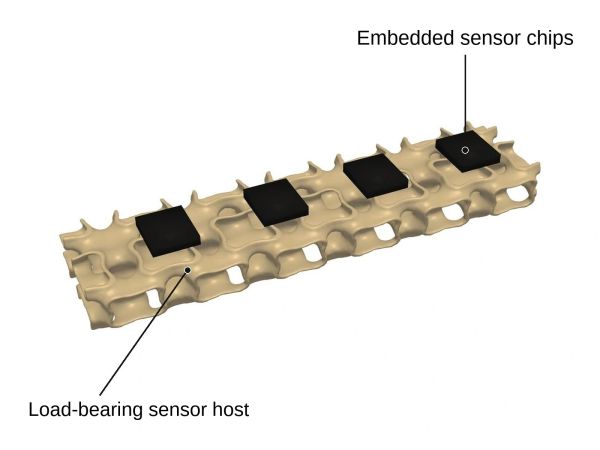
Architected hosts integrate strain, vibration and force sensors within load-bearing structure while tuning electromagnetic transmission for wireless readout. Applications include predictive maintenance of industrial equipment, force monitoring in assistive exoskeletons and battery-free implants that report healing in real time.
Catalytic and Energy Materials
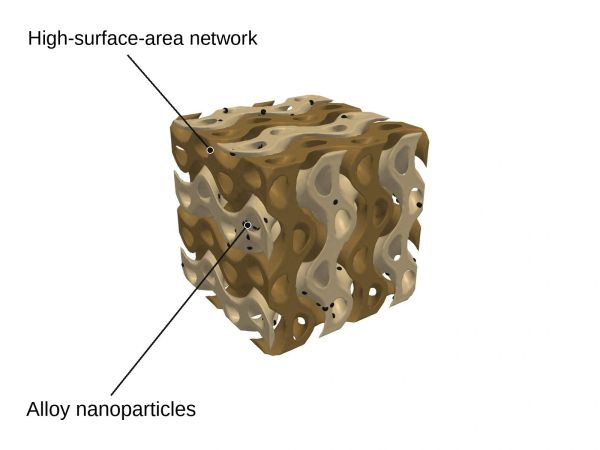
High-entropy alloy nanoparticles and single metal atoms anchored on high-surface-area architected networks combine efficient mass transport with dense active sites for electrocatalysis and energy conversion.